Bookings through this site are not open yet; it is looking for a local Rialto installer to work with. You can check typical prices below and ask to be notified.

How Thick Should a Concrete Driveway Be?

Concrete Foothill Rialto answers how thick a concrete driveway should be, a question with a clear answer for a car, a clear answer for an RV and an honest disagreement in the middle.

Check availability & price range Illustrated guide · RV Pads and Side-Yard Concrete
(909) 787-0050 Voicemail

Bookings aren't open yet. Leave your name and number; your message is recorded, and you'll get one message when a local installer is available.

Concrete Guides

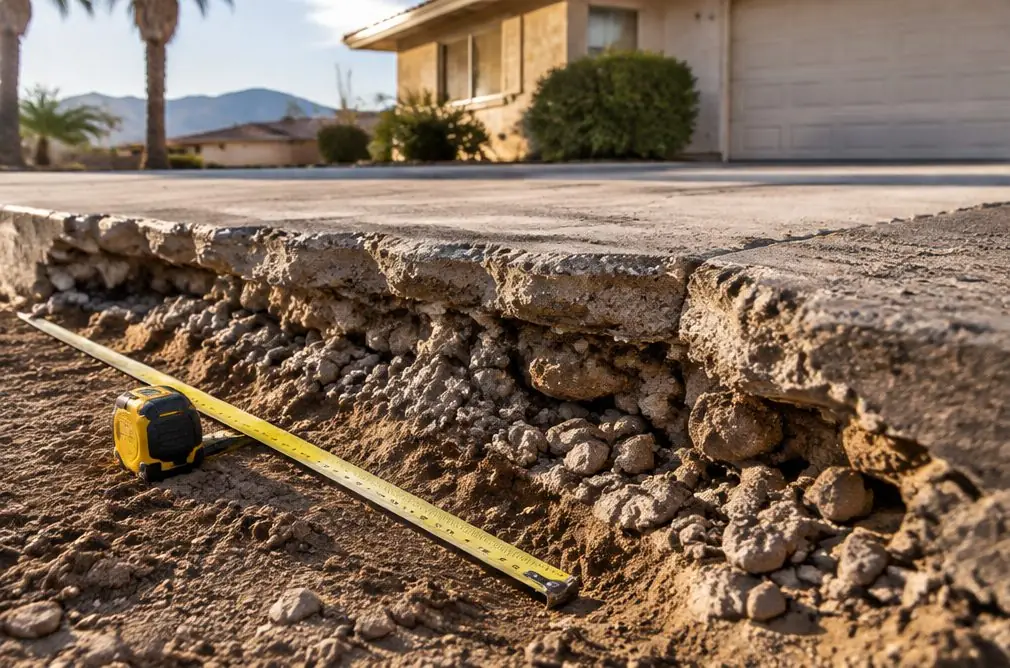
The slab as it starts

Illustration: a cut edge of a broken old driveway showing a thin slab over loose ground beside a tape measure Illustration
Concept illustration, AI-generated. Not a photo of a completed installation.

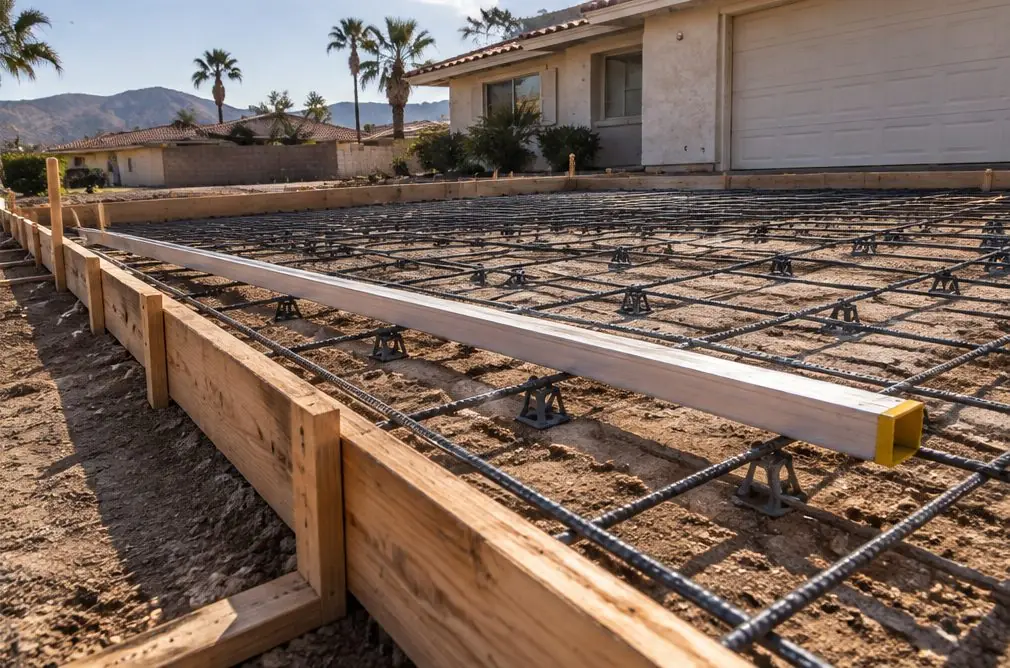
The planned slab (illustration)

Illustration: formwork for a new driveway with a rebar grid on chairs and a straightedge laid across the forms Illustration
Concept illustration, AI-generated. Not a photo of a completed installation.

The usual answers

Use Typical thickness Reinforcement often used
Walkway 4 in. Wire mesh or fiber
Patio 4 in. Wire mesh, fiber or a rebar grid
Car driveway 4 in.; some choose 5 in. A rebar grid on chairs
RV, trailer or truck pad 5–6 in. A rebar grid on chairs, closer spacing

One San Bernardino contractor's FAQ gives four inches against five to six inches with rebar, and a Los Angeles contractor's guide gives four inches as standard and five to six for RVs and heavy trucks.

Why weight matters

A slab spreads a wheel's load over the ground below it. A thicker slab spreads it wider and is stiffer, so it bends less. A motorhome puts a heavy load on a few tires, and a slab built for cars flexes under it and cracks, most often at the edges and where the wheels sit.

Where builders disagree

Some builders pour five inches for every car driveway because the extra inch is a small share of the cost. Others stay with four. Some add rebar everywhere; others use mesh or fiber for patios and walks. The disagreement is real, and a good quote says what thickness, what reinforcement and where it sits, so the buyer can weigh the choices.

What the extra inch costs

On the calculator, going from a four-inch slab with a rebar grid to a five-to-six-inch slab with rebar adds about $1 to $2 per square foot, or roughly $480 to $960 on a 480-square-foot pad, out of a total of several thousand. It is the cheapest insurance the slab offers.

Thickness is not everything

A thick slab on loose ground still cracks. The base, the compaction, the reinforcement at mid-depth, the joints and the cure matter as much. The thickness the contractor and the mix maker give is the right one for the job.

Where this leads

Check availability and the price range for this setup

Bookings aren't open yet — a typical Rialto range in about 30 seconds.

Step 1 Range —
    What is the concrete job?

    A new driveway, patio or walkway, a repair or a resurfacing, or a business property.

    How big is the slab?

    Typical: a two-car driveway, about 480 square feet.

    Length × width in feet; the square feet is the product.

    Which finish?

    Typical: a plain gray broom finish, the most common driveway surface.

    How thick, and what goes inside?

    Typical: 4 in. with a rebar grid for a car driveway; RVs and heavy trucks call for more.

    What comes out first?

    Typical: old concrete, since most Rialto driveways are replacements.

    Anything extra? optional

    Skip if none apply; an approach is only for work in the street right-of-way.

    How much needs fixing?

    Typical: half a driveway, about 240 square feet.

    What kind of repair?

    Typical: crack repair and sealing.

    What does the concrete look like now? pick all that apply

    Pick every line that fits; hairline cracks add nothing.

    Anything extra? optional

    Skip if none apply.

    What kind of surface?

    Pick the surface that carries the most traffic.

    How big is the area?

    Typical: a small lot, about 2,000 square feet.

    Which slab?

    Typical: 5 in. reinforced, for a lot with cars; trucks call for more.

    What else is in the scope? pick all that apply

    Pick every line that fits.

    When can the work happen? optional

    Typical: after hours or on a weekend. No price change.

    Anything extra? optional

    Skip if none apply.

    Notes and photos optional

    Optional: a short note, such as a slope, a gate or a tree near the slab.

    Additional files (optional) If you like, attach any file related to your request. Nothing is required. Please avoid photos of people, especially children, and documents with personal or financial details. Location data is removed from photos when they are received. Bookings through this site are not open yet, so no one reviews or prices these files. Up to 5 files, 10 MB each: photos (JPEG, PNG or WebP) or PDF.
      Your range

      A ZIP code is enough; email and phone are optional.

      • Pick the job, its size and a finish to see the range.

      Typical Rialto range—

      One message when bookings open

      Bookings through this site are not open yet. No installer will contact you. Your details are used only for the price range and, if you leave an email, one availability message.

      This site is operated by Liberty Horns LLC and is not a contractor. Price ranges are market estimates, not quotes. Privacy Policy.

      Typical Rialto area concrete prices, square foot by square foot

      Pick the job, the size and the details, and see the range. No contact details needed. Bookings open here once a local concrete contractor is named on this site.

      (909) 787-0050 Voicemail

      Bookings aren't open yet. Leave your name and number; your message is recorded, and you'll get one message when a local installer is available.

      Voicemail (909) 787-0050
      Enlarged photo