
Project example: a 12 by 40 foot RV pad beside the house — what happens and what it costs
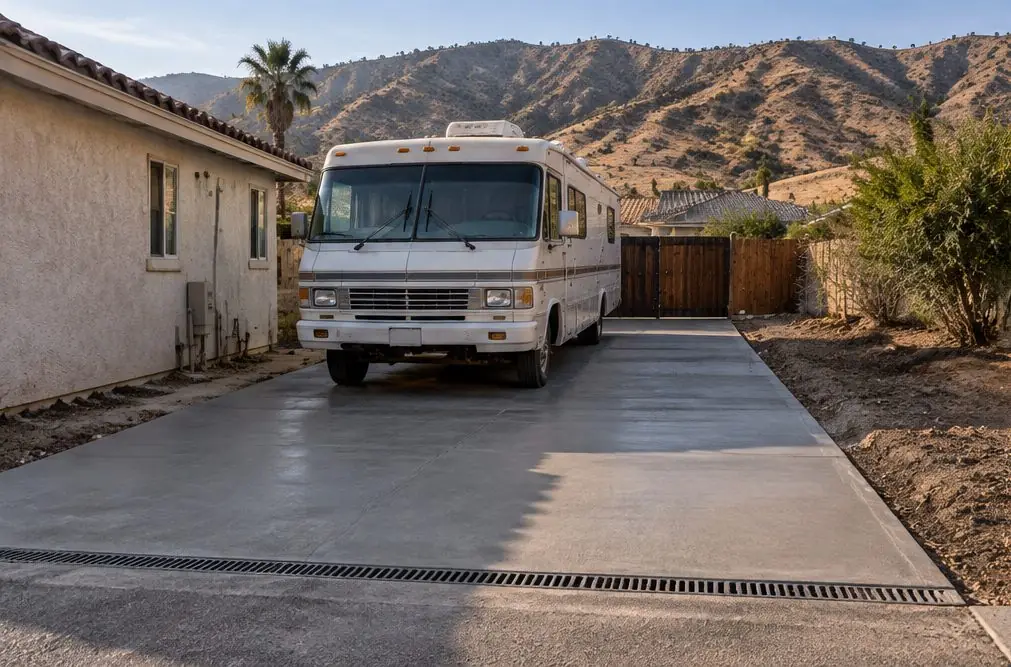
Concrete Foothill Rialto walks through a typical RV pad in a Las Colinas side yard: a 12 by 40 foot slab of 480 square feet, five to six inches thick with a rebar grid, with extra grading for a slope and a channel drain at the side gate.
Bookings aren't open yet. Leave your name and number; your message is recorded, and you'll get one message when a local installer is available.
Worked example. The pictures are AI concept illustrations, not photographs; no installation was performed or arranged through this site; prices are typical Rialto area market ranges, not quotes.
 Illustration
Project Examples & Typical Prices
The scenario
Picture a house on a foothill lot in North Rialto with a side yard that runs the length of the garage and a gate at the street end. The owners have a motorhome that has lived on the street in front of the house, and they want it on the lot, on concrete, behind the gate. The side yard is 12 feet wide and 40 feet long, which is the plan.
The first questions are not about concrete. They are about where the pad can go and what the rules allow: the property line, any easement along the side yard, the setbacks and, if the community has an association, what it says about RVs. The owners confirm the lines with a survey and the rules with the city and the CC&Rs. Seller listings in this area often mention RV parking, but that says nothing about a particular lot.
Then the load. A motorhome puts far more weight on far less surface than a car does, and most of it sits on a few tires. So the slab is five to six inches thick, with a rebar grid on chairs laid closer than for a driveway, and thicker edges where the wheels will sit. The ground is graded so the slab falls away from the house and the neighbor's fence, and because the side yard slopes toward the gate, a channel drain is cut across the slab at the gate so water does not pond there or run into the street.
The pour starts early in the morning, and the slab is kept moist for the first week. The owners hold off on driving the motorhome onto it for about four weeks, the longer wait the contractor gives for heavy loads.
What the job involves
- The lot is surveyed, the side yard is measured, and the setbacks, easements and association rules are confirmed before any ground is broken.
- The side yard is graded to a planned fall away from the house, with extra grading where the slope runs toward the gate.
- The base is compacted, forms are set for the edges and the thicker wheel lines, and a rebar grid is laid on chairs.
- The concrete is placed and screeded, finished with a broom finish for grip, and control joints are cut.
- A channel drain is set and the slab is formed around it so water runs to it from the pad.
- The slab is kept moist while it cures; the motorhome waits for the longer days a heavy load needs.
Materials and tools
- A survey stake set, forms and a compacted base
- Rebar on chairs and a channel drain with its grate
- A mixer truck's load, screed and a broom
- Curing cover or curing compound
What it typically costs in the Rialto area
| Broom finish, plain gray, 480 square feet installed ($7–$10 per sq ft) | $3,360–$4,800 |
| 5–6 in. with rebar (+$2–$3.50 per sq ft) | +$960–$1,680 |
| Extra grading for a sloped yard | +$300–$1,500 |
| Channel drain, 10 ft section × 1 section | +$250–$700 |
| Typical total | $4,870–$8,680 (market range, not a quote) |
These are typical local ranges, not a quote or an offer; an installer prices the actual job after seeing the slab.
Add-ons often paired with this job
- Extra grading for a sloped yard — +$300–$1,500. Extra grading for a sloped yard is a separate flat line.
- Channel drain, 10 ft section — +$250–$700. A channel drain is priced per 10-foot section, one section here.
- Sealer after the cure — +$250–$900. Sealer is a separate flat line, not used here.
Why it is done this way
The arithmetic of an RV pad is the arithmetic of a driveway with a thicker slab. A per-square-foot rate for the broom finish, a larger per-square-foot add-on for the five-to-six-inch build with rebar, and two flat lines for the grading and the drain. The calculator adds them the same way.
What an RV pad adds is the weight and the narrowness of the space. Contractors commonly give four inches as the standard for cars and five to six inches with rebar for RVs and heavy trucks, and the whole slab is built to that load: base, reinforcement, edges and joints. A slab that is thin under a motorhome cracks and settles where the wheels sit, and the repair costs more than the extra concrete would have.
Narrowness makes drainage a design problem. A side yard has no room for water to go except along it, so the slope, the gate and the drain are planned together. A rule worth saying aloud: runoff is sloped away from the house and kept off the neighbor's property.
The question that comes first and has nothing to do with concrete is whether the pad is allowed. The slab does not make parking legal. The city, the setbacks and any association do, and the concrete follows their answers.
What would change the price
- The motorhome is heavier or longer than assumed, and the slab grows thicker or longer.
- The side yard has an easement or a utility that cuts the pad in two.
- Old concrete or pavers have to be removed first.
- The gate swing needs a wider opening and a re-formed edge.
- A sealer is added to the finished slab.
Where this leads
- Service page: RV Pads and Side-Yard Concrete — A heavier slab for an RV, trailer or side-yard access, and what to settle before it is poured.
- Local page: Concrete in Las Colinas
- All services and typical prices: Concrete in Rialto
- More worked examples: Project Examples & Typical Prices
Check availability and the price range for this setup
Bookings aren't open yet — a typical Rialto range in about 30 seconds.