
Project example: a front walkway with three steps around a mature tree — what happens and what it costs
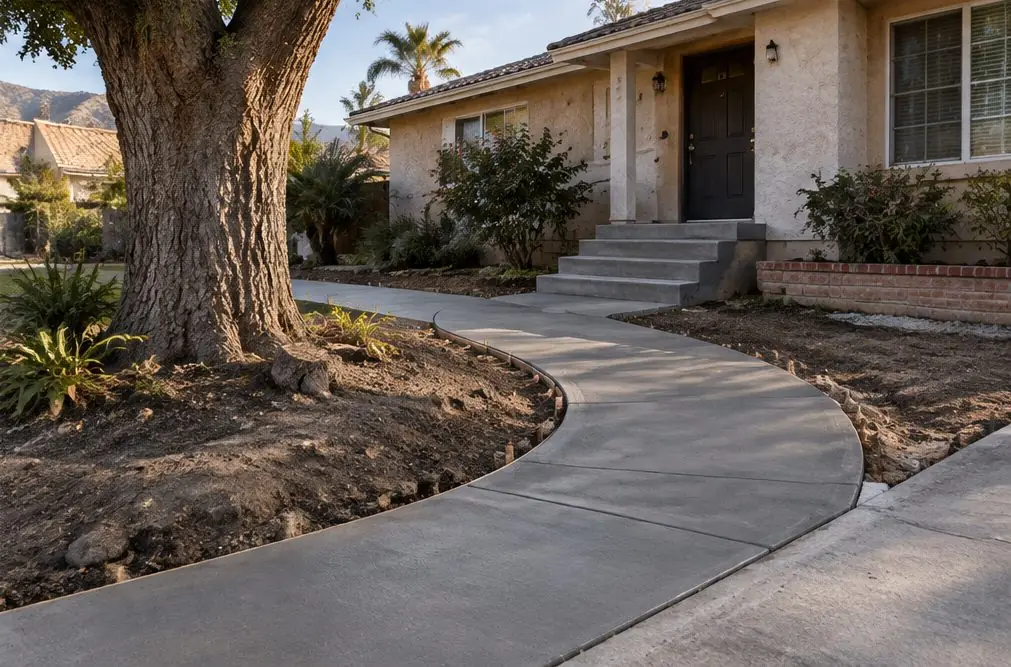
Concrete Foothill Rialto walks through a typical front walkway in an established El Rancho Verde yard: a 4 by 30 foot slab of 120 square feet with three concrete steps at the door, laid out around a mature tree whose root has to be dealt with.
Bookings aren't open yet. Leave your name and number; your message is recorded, and you'll get one message when a local installer is available.
Worked example. The pictures are AI concept illustrations, not photographs; no installation was performed or arranged through this site; prices are typical Rialto area market ranges, not quotes.
 Illustration
Project Examples & Typical Prices
The scenario
Picture an established street near the golf course, with tall trees on both sides and a front yard shaded by a mature tree that was planted before the house was sold twice. The old path from the driveway to the front door is a row of cracked pavers that tilt and trip, and the owners want a smooth concrete walkway instead, four feet wide, about 30 feet long, with three steps at the door.
The tree is the first design decision. Its roots run under the old path, and one of them has lifted the pavers. Cutting a major root can hurt a tree, so the contractor looks at its size and where it meets the trunk, and finds a medium-sized root that can be cut cleanly. A root barrier goes in along the new path's edge to keep the next root from taking the same route. The tree is the owners', so the decision is theirs; had it been a street tree, the city would be the one to ask.
The walkway curves gently around the trunk to give the roots room, with a slight slope across its width so water runs off. A flat landing at the door gives room to open the door and step out, and the three steps are formed with an even rise and run from bottom to top, because an uneven step is the one people trip on. The surface is a broom finish, and the owners choose a slip-resistant sealer for the steps.
The slab is four inches thick with wire mesh, with control joints at regular intervals. It is poured in the morning and kept moist while it cures.
What the job involves
- The tree is looked at, the root is traced and its size noted; the owners decide whether to cut it, and a root barrier is planned.
- The old pavers are lifted and hauled, the ground is graded and the base compacted along the new path.
- Forms are set for the curve, the landing and the three steps, and wire mesh is laid on chairs.
- The concrete is placed and screeded and the steps are formed; the walkway gets a broom finish and control joints.
- A slip-resistant sealer goes on the steps after the cure.
- The path stays closed to foot traffic for the day or two the contractor gives, and the slab is kept moist.
Materials and tools
- Forms for a curve and a stepped landing
- Wire mesh on chairs and a compacted base
- A root barrier panel and a pruning saw for a cut root
- A broom, edgers and a slip-resistant sealer
What it typically costs in the Rialto area
| Broom finish, plain gray, 120 square feet installed ($7–$10 per sq ft) | $840–$1,200 |
| Concrete steps × 3 steps | +$450–$1,200 |
| Tree root cutting or a root barrier | +$300–$1,200 |
| Typical total | $1,590–$3,600 (market range, not a quote) |
These are typical local ranges, not a quote or an offer; an installer prices the actual job after seeing the slab.
Add-ons often paired with this job
- Concrete steps — +$150–$400. The steps are priced per step, three here.
- Tree root cutting or a root barrier — +$300–$1,200. A root cut or root barrier is a separate flat line.
- Sealer after the cure — +$250–$900. Sealer is a separate flat line, not used in this price.
Why it is done this way
A walkway is the smallest job on the site, and the arithmetic is the plainest: a per-square-foot rate for the finish, no extra for a mesh slab, and two small lines, one for the steps and one for the root. The price is a thousand dollars or two, and the reason it is worth the page is the details that cost nothing to get right.
The first is the tree. A path that ignores a root is a path that will be lifted again, and in an established neighborhood with mature trees, roots are the main reason concrete fails. Dealing with the root, whether by cutting it or planning around it, is part of the job, not an extra.
The second is the steps. A flight of steps has to be even. Rise and run follow the building code, and whether a handrail is needed depends on the height; the city answers for an address. A broom finish helps, and so does a slip-resistant sealer on a surface that is exposed to sprinklers.
The third is the line between the walkway and the public sidewalk. The path on the lot is private. The sidewalk along the street lies in the public right-of-way, and the city's conditions apply to work there. A walkway that ends at the sidewalk is finished at the lot line.
What would change the price
- The root is larger than expected and the path is rerouted.
- The path grows wider or longer, or adds a second landing.
- Old concrete under the pavers has to be broken out.
- The owners choose a stamped or colored finish.
- A handrail or a wall is added at the steps.
Where this leads
- Service page: Sidewalks, Walkways and Steps — Private walkways and steps, and where the public sidewalk begins.
- Local page: Concrete in El Rancho Verde
- All services and typical prices: Concrete in Rialto
- More worked examples: Project Examples & Typical Prices
Check availability and the price range for this setup
Bookings aren't open yet — a typical Rialto range in about 30 seconds.