
Project example: replacing a cracked two-car driveway with a new approach — what happens and what it costs
Concrete Foothill Rialto walks through a typical replacement in a Central Rialto house of the 1970s: a 480-square-foot two-car driveway with old concrete removed, a new 4-inch broom-finish slab with a rebar grid, a new approach across the sidewalk strip and a coat of sealer.
Bookings aren't open yet. Leave your name and number; your message is recorded, and you'll get one message when a local installer is available.
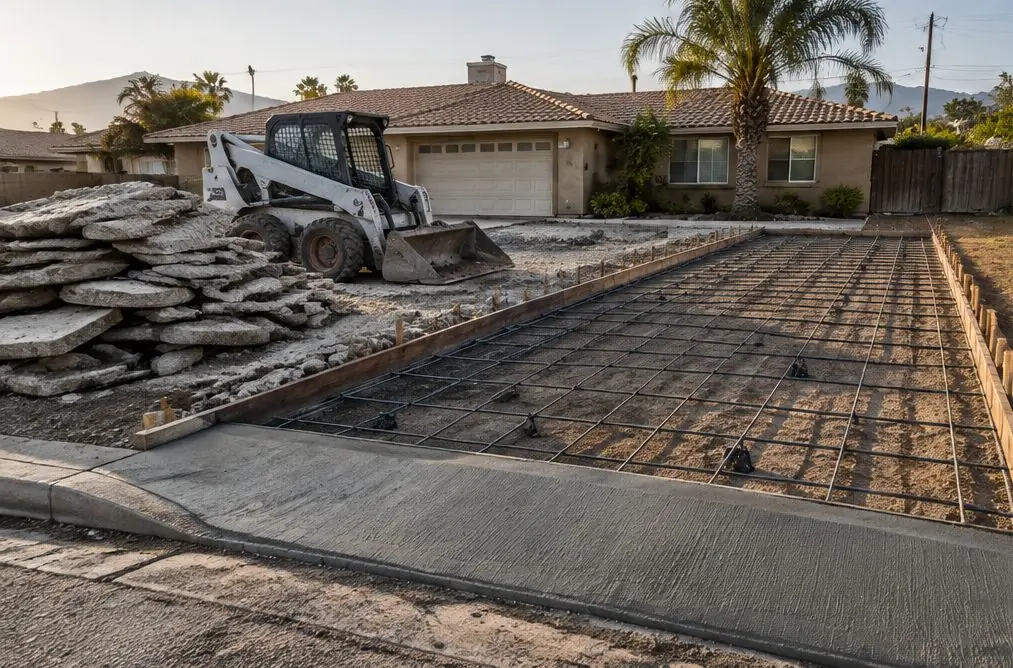
Worked example. The pictures are AI concept illustrations, not photographs; no installation was performed or arranged through this site; prices are typical Rialto area market ranges, not quotes.
 Illustration
Project Examples & Typical Prices
The scenario
Picture a single-story house on a street of 1970s homes near Foothill Boulevard. The driveway is a two-car slab, about 20 by 24 feet, with a straight crack through the middle panels, a corner that has dropped an inch and a patch of flaking near the garage door. Forty summers of sun and sprinkler water have done their work, and the owners have decided that a patch will not hold.
The first thing the contractor asks about is the street. The old driveway runs out across the sidewalk strip to a short apron at the curb, and that apron is cracked too. The strip between the lot line and the street is the public right-of-way. The City of Rialto's published encroachment permit conditions govern work there: a permit from Public Works, a business license, liability insurance naming the city, a traffic control plan, a utility locate and a survey for lines and grades. The owners and the contractor agree in writing who handles each step, and that the city, not the contractor, issues any permit.
On the private side the plan is simple. The old slab is sawn into pieces and hauled away. The ground is regraded to a gentle fall away from the garage door, the base is compacted, forms are set and a rebar grid goes in on chairs at mid-depth. The new slab is four inches thick with a broom finish and control joints cut into near-square panels. A sealer goes on after the cure.
The work starts early in the morning, because Rialto summers are hot and a pour in the afternoon sun dries too fast. The slab is kept moist while it cures, and the family parks on the street until the contractor says cars can return.
What the job involves
- The driveway is measured, the cracks and the settled corner are photographed, the property line is confirmed and the street-side work is written down as a separate item.
- The utility locate is called in before any digging, and the old slab is sawn into manageable pieces along the joints and the edges.
- The pieces are broken out, loaded and hauled to a disposal facility; washout and dust are kept out of gutters and storm drains.
- The ground is graded to the planned slope and the base is compacted; forms are set for the edges and the thickness.
- A rebar grid is laid on chairs, the concrete is placed and screeded, the surface is floated and given a broom finish, and control joints are cut.
- The slab is kept moist while it cures, sealer is applied after the cure, and the family waits for the contractor's days before driving on it.
Materials and tools
- A concrete saw with water or vacuum dust control and a skid steer for breaking out
- Forms, a compacted base and a rebar grid on chairs
- A mixer truck's load, screed, floats, brooms and a joint cutter
- Curing cover or curing compound, and sealer
What it typically costs in the Rialto area
| Broom finish, plain gray, 480 square feet installed ($7–$10 per sq ft) | $3,360–$4,800 |
| 4 in. with a rebar grid (+$1–$1.50 per sq ft) | +$480–$720 |
| Remove old concrete and haul away (+$2–$3.50 per sq ft) | +$960–$1,680 |
| Driveway approach in the street (city permit is separate) | +$1,500–$4,500 |
| Sealer after the cure | +$250–$900 |
| Typical total | $6,550–$12,600 (market range, not a quote) |
These are typical local ranges, not a quote or an offer; an installer prices the actual job after seeing the slab.
Add-ons often paired with this job
- Driveway approach in the street (city permit is separate) — +$1,500–$4,500. The street approach is a separate flat line, and city fees, the survey and traffic control are extra lines on top.
- Sealer after the cure — +$250–$900. Sealer after the cure is a separate flat line.
- Channel drain, 10 ft section — +$250–$700. A channel drain is a per-section option, not used here.
Why it is done this way
This is the most common Rialto concrete job, and its price is easy to read once the lines are laid out. A per-square-foot rate for the broom finish, an add-on per square foot for the rebar grid, a second add-on per square foot for taking the old concrete out and hauling it away, and two flat lines for the approach and the sealer. The calculator on the home page adds them the same way.
The line most owners are surprised by is the approach. The driveway on the lot is the contractor's and the owner's to plan; the apron at the curb sits in the public right-of-way, and the city's documents spell out who can work there and under what conditions. It can be a small part of the concrete and a large part of the paperwork. Asking early who applies, who pays the fees and who is on site for the inspection is cheaper than learning it after a crew has arrived.
The city's conditions also say that a damaged concrete driveway that is one monolithic piece is removed and replaced in its entirety, and that one poured together with the sidewalk is separated from it by a saw cut. That is why a quote for a right-of-way section tends to name panels, not patches.
Thickness is the other decision worth making in writing. Four inches with rebar is common for cars. Owners who expect a delivery truck, a trailer or an RV on the slab often choose more, and the extra inch or two is the cheapest insurance the slab offers.
What would change the price
- The old slab turns out to sit on poor ground, and extra base or grading is added.
- The owners choose a colored, exposed aggregate or stamped finish.
- The approach grows to include a damaged curb or gutter section.
- A tree root has to be cut, or a root barrier added.
- The slope needs a channel drain at the garage door.
Where this leads
- Service page: Driveway Replacement — How a tear-out and replacement goes in a Rialto driveway, what comes out first and what it typically costs.
- Local page: Concrete in Foothill and Central Rialto
- All services and typical prices: Concrete in Rialto
- More worked examples: Project Examples & Typical Prices
Check availability and the price range for this setup
Bookings aren't open yet — a typical Rialto range in about 30 seconds.