
Project example: a 12 by 16 foot stamped and colored patio — what happens and what it costs
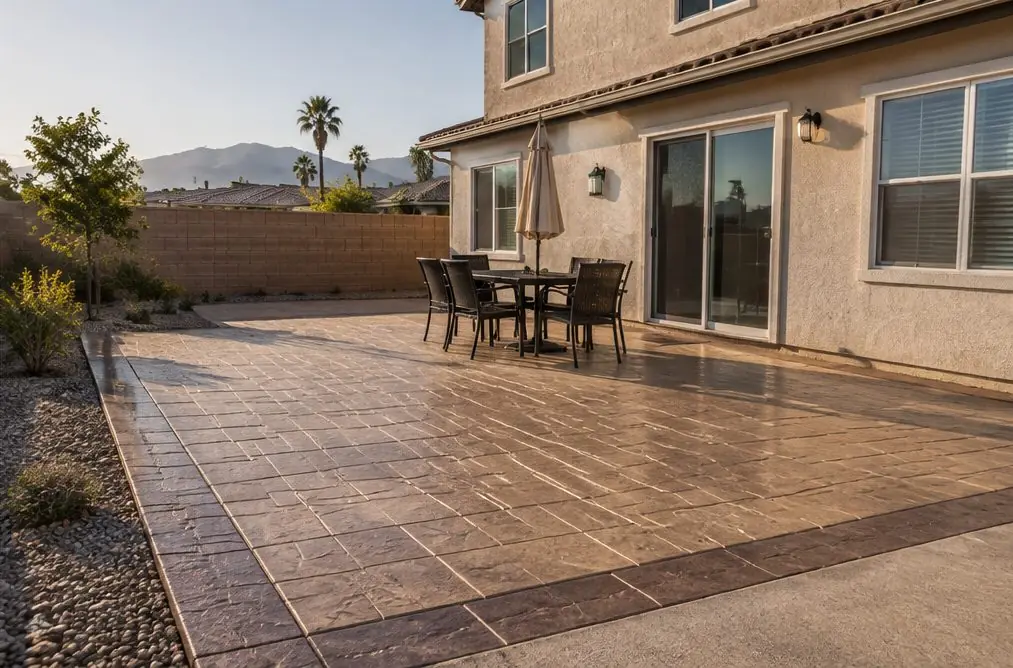
Concrete Foothill Rialto walks through a typical stamped patio in a newer Renaissance home: a 192-square-foot slab with wire mesh, an ashlar slate pattern in a warm tan with a dark release color, a border band of four 10-foot sections and a coat of sealer.
Bookings aren't open yet. Leave your name and number; your message is recorded, and you'll get one message when a local installer is available.
Worked example. The pictures are AI concept illustrations, not photographs; no installation was performed or arranged through this site; prices are typical Rialto area market ranges, not quotes.
 Illustration
Project Examples & Typical Prices
The scenario
Picture a newer house in a planned community in North Rialto with a back yard of bare dirt and a block wall. The family wants a patio for a table for six and a barbecue, big enough to walk around and small enough to leave a strip of yard. Twelve by sixteen feet is the plan.
Before anything is ordered, the owners read the association's rules. The CC&Rs say exterior concrete is an architectural-review item, so they send in a sketch with the size, the pattern and the color, and wait for the approval to come back. A contractor cannot approve it and no page can promise it; the association decides.
The pattern is an ashlar slate in a warm tan with a dark brown release color that stays in the low spots and gives the stone an antique shading. A band of a darker color frames the patio, made of four 10-foot sections. The owners ask about heat, because the yard has no shade. The contractor shows a small sample slab in the afternoon sun and points out that the darker tones get hotter, so the base color stays light and the border is the only dark element.
The slab is four inches thick with wire mesh set at mid-depth, sloped away from the house at a gentle fall, with a joint at the house wall so the patio does not lock onto it. After the cure the surface is washed and sealed. The sealer gives sheen and protects the color, and the contractor adds a slip-resistant additive because a sealed stamped surface can be slippery when wet.
What the job involves
- The yard is measured, the slope and the house wall are noted and the sketch goes to the association for architectural review.
- Forms are set for the edges and the border, the ground is graded and the base is compacted.
- Wire mesh is laid on chairs and the slab is poured and screeded; the base color is placed and the surface floated.
- The release color is dusted on and the stamping mats are pressed in, pattern by pattern, working across the slab.
- Control joints are cut in the grid the pattern allows, and the slab is kept moist while it cures.
- The surface is washed, dried and sealed, with a slip-resistant additive in the sealer.
Materials and tools
- Forms, a compacted base and wire mesh on chairs
- Pigmented concrete and a release color
- Rubber stamping mats and tampers
- A pressure washer and a roller for the sealer
What it typically costs in the Rialto area
| Stamped and colored, 192 square feet installed ($12–$19 per sq ft) | $2,304–$3,648 |
| Border band, 10 ft section × 4 sections | +$360–$880 |
| Sealer after the cure | +$250–$900 |
| Typical total | $2,914–$5,428 (market range, not a quote) |
These are typical local ranges, not a quote or an offer; an installer prices the actual job after seeing the slab.
Add-ons often paired with this job
- Border band, 10 ft section — +$90–$220. The border band is priced per 10-foot section, four sections here.
- Sealer after the cure — +$250–$900. Sealer after the cure is a separate flat line.
- Extra grading for a sloped yard — +$300–$1,500. Extra grading for a slope is a separate flat line, not used here.
Why it is done this way
A stamped patio costs more per square foot than a plain one, and the table above shows where the difference goes: the pigmented mix, the release color, the stamping labor and the sealer. The slab itself, the base, the mesh and the pour are the same as for a plain patio.
That makes stamped concrete a decision about the surface, not the structure. A cracked panel in a stamped patio is harder to repair than in a plain one, because the pattern is hard to match, and a long straight pattern shows a settled panel more than an irregular stone does. An ashlar slate was chosen here partly because it hides small flaws.
The sealer is a maintenance step. It wears with sun and use, and it needs renewing on a schedule the product's label gives. Owners who skip it find the color fading and the surface dulling. Owners who choose a high-gloss sealer find it slippery after a sprinkler cycle, which is why grip is part of the conversation.
Heat is the last practical point. Rialto summers run to the low and mid 90s in July, and a dark surface in direct sun can be uncomfortable barefoot. A sample slab in the afternoon sun is a cheap way to find out.
What would change the price
- The owners choose a different pattern, color or a second border.
- The patio grows or an extra step to the house door is added.
- The yard slopes and needs extra grading or a drain.
- The association asks for a different color or finish.
- A shade structure's footings are poured into the slab.
Where this leads
- Service page: Stamped Concrete — How stamped and colored concrete is made and kept, and what a stamped patio typically costs.
- Local page: Concrete in Renaissance
- All services and typical prices: Concrete in Rialto
- More worked examples: Project Examples & Typical Prices
Check availability and the price range for this setup
Bookings aren't open yet — a typical Rialto range in about 30 seconds.