
Project example: a dumpster pad and a small truck apron on a business property — what happens and what it costs
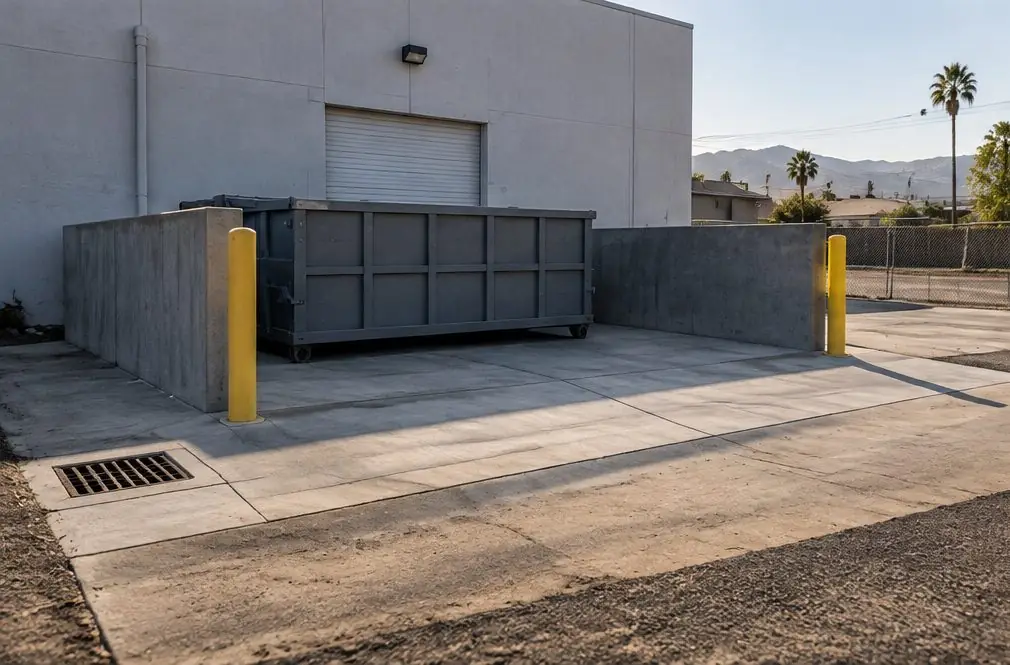
Concrete Foothill Rialto walks through a typical small job on a business property in the North Rialto logistics district: a 600-square-foot dumpster pad and truck apron, 6 inches thick and reinforced, with the old pavement removed, joints sealed, two bollards and the work done in phases.
Bookings aren't open yet. Leave your name and number; your message is recorded, and you'll get one message when a local installer is available.
Worked example. The pictures are AI concept illustrations, not photographs; no installation was performed or arranged through this site; prices are typical Rialto area market ranges, not quotes.
 Illustration
Project Examples & Typical Prices
The scenario
Picture a small distribution building in the logistics district just north of the 210, with a service yard behind it where trucks back up to a dock and a dumpster hauler empties a bin twice a week. The asphalt in front of the bin has been broken up by the hauler's wheels and by the weight of a loaded bin, and the property manager wants a concrete pad and a short truck apron in its place, about 600 square feet in all.
A business slab begins with a plan. The property owner's designer has drawn the pad with a thickness, a slope and the position of a drain, and the contractor builds to it. The pad takes a loaded bin and the impact of the hauler, and the apron takes trucks turning in a small radius, so the slab is six inches thick and reinforced, with joints laid out for the traffic.
The yard cannot close. The building's tenants load and unload through the day, so the work is phased: the old asphalt and the first half of the new slab on one weekend, the second half on the next, with a barrier between the phases and a temporary place for the bin. The schedule is a note for the contractor, not a price change.
The existing pavement is sawn, broken out and hauled away. The ground is regraded and the base compacted. Rebar is laid, the concrete is placed, and a sloped surface leads water to a drain at one corner, with washout kept out of storm drains. Saw cuts are made and sealed after the cure. Two bollards go in beside the pad to protect the building wall.
What the job involves
- The designer's plan is reviewed with the property manager, the phases are agreed and a place for the bin during the work is set aside.
- The old asphalt is saw-cut at the phase line, broken out and hauled away; dust and washout are controlled.
- The base is regraded and compacted, forms are set for the pad and the apron, and rebar is laid on chairs.
- The first phase is poured, finished with a broom finish and sawn into panels, and kept moist while it cures.
- The second phase follows with the same build, the joints between phases are tied in, and the drain is set.
- The joints are sealed after the cure, the bollards are set and the yard is opened to trucks after the contractor's days for heavy loads.
Materials and tools
- A concrete saw with water or vacuum dust control and a loader or skid steer
- Rebar on chairs, forms and a compacted base
- A pump or a truck's chute, screed and a power trowel
- Joint sealant, a drain with a grate and two steel bollards
What it typically costs in the Rialto area
| 6 in. reinforced, 600 square feet installed ($10–$15 per sq ft) | $6,000–$9,000 |
| Remove existing pavement (+$2–$4 per sq ft) | +$1,200–$2,400 |
| Joint sealing (+$1–$1.50 per sq ft) | +$600–$900 |
| Bollards × 2 bollards | +$500–$1,400 |
| Haul-away of broken pavement | +$500–$3,000 |
| Typical total | $8,800–$16,700 (market range, not a quote) |
These are typical local ranges, not a quote or an offer; an installer prices the actual job after seeing the slab.
Add-ons often paired with this job
- Bollards — +$250–$700. Bollards are priced each, two here.
- Haul-away of broken pavement — +$500–$3,000. Haul-away of the broken pavement is a separate flat line.
- Accessible-route items: ramps and detectable warnings, as the site plan calls for — +$800–$3,000. Accessible-route items follow the site plan and are not part of this example.
Why it is done this way
The price of this example is larger than any home job, and the reason is not complicated. A business slab is thicker, it is reinforced, it has more joints and it is built to a plan. The per-square-foot rate for six inches is higher than for a car driveway, the modifiers add the removal of the existing pavement and the joint sealing, and the options add the bollards and the haul-away.
A truck court or a dumpster pad takes the heaviest loads a lot sees, and the sharpest: a loaded bin dropped by a hauler or a trailer turning in a small radius twists the slab where a car would only roll over it. That is why the pad is thicker than a lot for cars, and why the joint layout matters. A joint carries traffic from one panel to the next, and a joint that fails is the first place a court shows wear.
The schedule is what makes the job a business one. A tenant cannot lose a dock for a week. The work is cut into phases that fit around the building's day, and the contractor plans around the loading, the barrier and the bin.
This site covers private property only. A public street or a city curb is public works and sits outside it, and the owner's designer and the property's plan decide the details.
What would change the price
- The plan calls for eight inches of heavy-duty slab rather than six.
- The pad needs a drain and a wash area with a sump.
- The phases lengthen because the dock cannot close.
- The apron grows to the length of a truck court.
- A second dumpster or an equipment pad is added.
Where this leads
- Service page: Warehouse Aprons and Truck Courts — What a truck court and a loading apron need underneath and in their joints, and what they typically cost.
- Local page: Concrete in The Northern Logistics District
- All services and typical prices: Concrete in Rialto
- More worked examples: Project Examples & Typical Prices
Check availability and the price range for this setup
Bookings aren't open yet — a typical Rialto range in about 30 seconds.