
Project example: a small private parking lot with an accessible path — what happens and what it costs
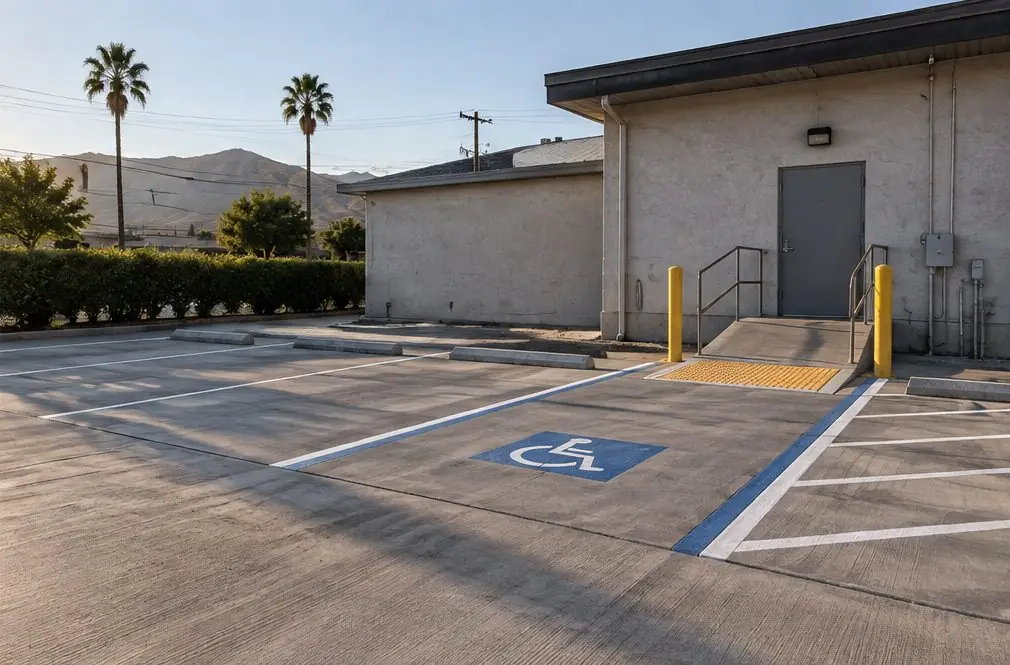
Concrete Foothill Rialto walks through a typical small private lot in Downtown Rialto: a 1,200-square-foot parking area behind a commercial building, 5 inches thick and reinforced, with old pavement removed, joints sealed, striping, accessible-route items built to the site plan and two bollards.
Bookings aren't open yet. Leave your name and number; your message is recorded, and you'll get one message when a local installer is available.
Worked example. The pictures are AI concept illustrations, not photographs; no installation was performed or arranged through this site; prices are typical Rialto area market ranges, not quotes.
 Illustration
Project Examples & Typical Prices
The scenario
Picture a one-story commercial building near the old downtown with a small lot behind it: six stalls, a drive aisle and a back door. The asphalt is cracked and patched, the accessible space has faded, and a ramp to the door has settled. The owner is replacing the lot with concrete, about 1,200 square feet in all, and has an architect's site plan that shows the stall layout and the accessible route.
The slab is the contractor's work, and the layout is the plan's. The site plan sets where the accessible space and its route go, the slope of the ramp and the textured warning surface at its foot. The contractor builds the ramp, the route and the warning strip to that plan. The owner's designer and the building department answer for whether the layout meets the accessibility rules; this page does not say it does.
The lot takes cars and the occasional delivery van, so the slab is five inches thick and reinforced, with control joints cut at the stall lines where possible and sealed after the cure. The old asphalt is sawn, broken out and hauled away. The base is regraded and compacted, a gentle slope leads water to the street-side drain, and washout stays out of the storm drain.
The lot serves a business that opens at eight, so the work is done after hours and on a weekend. Striping and the symbol for the accessible space go on after the cure, and two bollards protect the corner of the building at the walk.
What the job involves
- The site plan is reviewed with the owner and the contractor, and the phases and the after-hours schedule are agreed.
- The old asphalt is saw-cut, broken out and hauled away, with dust and washout controlled.
- The base is regraded and compacted; forms and rebar go in to the plan's slopes, including the ramp.
- The slab is poured, finished with a broom finish, jointed and kept moist while it cures.
- The joints are cleaned and sealed after the cure; the textured warning surface is set at the ramp to the plan.
- Striping, the accessible symbol and the bollards are installed, and the lot reopens after the contractor's days for cars.
Materials and tools
- A saw with water or vacuum dust control, forms and rebar on chairs
- A mixer truck's load, a screed and a power trowel
- Joint sealant and paint for stripes and symbols
- A textured warning surface to the plan and two steel bollards
What it typically costs in the Rialto area
| 5 in. reinforced, 1,200 square feet installed ($8–$13 per sq ft) | $9,600–$15,600 |
| Remove existing pavement (+$2–$4 per sq ft) | +$2,400–$4,800 |
| Joint sealing (+$1–$1.50 per sq ft) | +$1,200–$1,800 |
| Striping and wheel stops (+$0–$1 per sq ft) | +$0–$1,200 |
| Accessible-route items: ramps and detectable warnings, as the site plan calls for | +$800–$3,000 |
| Bollards × 2 bollards | +$500–$1,400 |
| Typical total | $14,500–$27,800 (market range, not a quote) |
These are typical local ranges, not a quote or an offer; an installer prices the actual job after seeing the slab.
Add-ons often paired with this job
- Accessible-route items: ramps and detectable warnings, as the site plan calls for — +$800–$3,000. Accessible-route items are priced as a flat line and follow the site plan.
- Bollards — +$250–$700. Bollards are priced each, two here.
- Haul-away of broken pavement — +$500–$3,000. Haul-away of the broken pavement is a separate flat line, not in this price.
Why it is done this way
The numbers read like a larger version of a driveway, with the extras a business needs: removal of the old pavement, joint sealing, striping and wheel stops as modifiers per square foot, and the accessible-route items and bollards as flat and per-unit lines. The calculator adds them the same way as for a home.
What makes a lot different is the plan. The slab is poured by a contractor, but the layout belongs to the owner's designer, and the accessible route is set by state and federal accessibility rules and the site plan. This page, like every page on the site, makes no promise that a layout meets them; the building department confirms, and a licensed designer answers for the plan.
A second difference is the schedule. A business that opens in the morning cannot have a lot closed. After-hours work, a plan for where cars go, and a short list of the days the lot stays closed are part of the quote. They are also why a lot is poured in phases and not in one go.
A third is the joint plan. A large slab is cut into panels, the cuts are sealed against water and grit, and where the stalls are painted the joints can follow the stall lines, which keeps the lot tidy as it ages.
What would change the price
- The site plan calls for a different slope or a larger accessible route.
- The old asphalt sits on a poor base and extra grading is added.
- The lot grows to include a second drive aisle.
- Wheel stops are replaced by curbs.
- The work moves from after hours to business hours and takes longer.
Where this leads
- Service page: Parking Lot Concrete and Accessible Paths — A private parking surface with its accessible route, who decides the layout and what the concrete typically costs.
- Local page: Concrete in Downtown Rialto
- All services and typical prices: Concrete in Rialto
- More worked examples: Project Examples & Typical Prices
Check availability and the price range for this setup
Bookings aren't open yet — a typical Rialto range in about 30 seconds.